Enhancement Of Inside Tube Flow Boiling Heat Transfer Of Eco-Friendly Refrigerants.
Sponsor: SERB (DST)
Project Outlay: ₹43 Lacs
Prof. Arup Kumar Das
Abstract
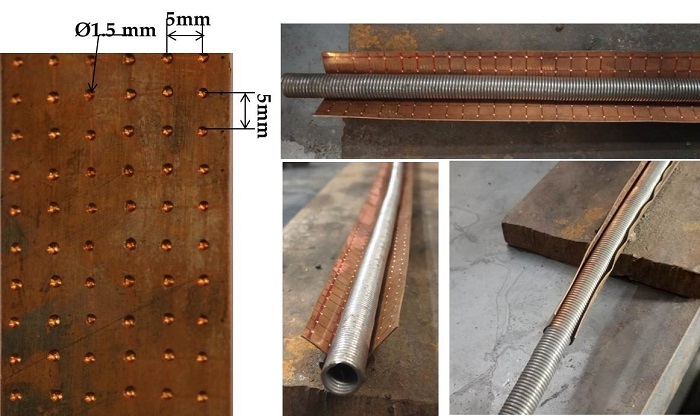
Present project aims at augmentation of flow boiling heat transfer inside tubular surfaces considering conventional and ozone-safe/eco-friendly refrigerants as working fluid. Sustained increase in heat transfer coefficient with aging requires increase in active nucleation sites and simultaneous arrangement of liquid replenishment on the tube surface. Both of these can be achieved by structuring inside the boiling tube surface as reentrant geometry. This enhancement technique neither needs any auxiliary power nor gives rise to an excessive pressure drop.
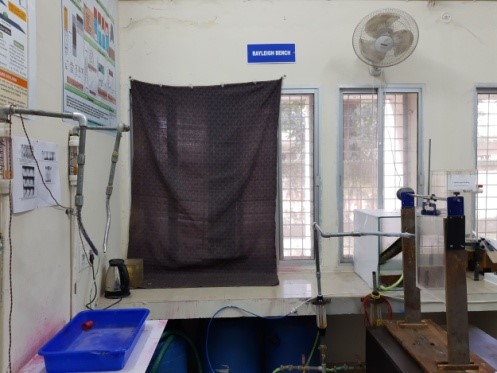
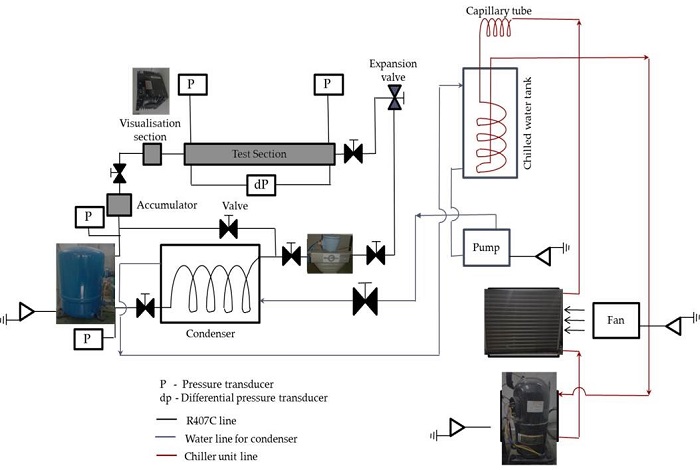
Using advanced manufacturing methods like wire EDM, combination of micro drill and form brazing and powder metallurgy and spot joining, interconnected channels are prepared on tube to observe the increased heat transfer. Development of structured channels on the tube surface requires proper design, innovative fabrication and intelligent characterization of the surface. An indigenous facility for checking the flow boiling heat transfer coefficient has been developed to test the developed surface for different ozone-safe/eco-friendly refrigerants
Schematic Of Experimental Setup For Evaluation Flow Boiling Heat Transfer Characteristics
Development Of New Enhancement Tube
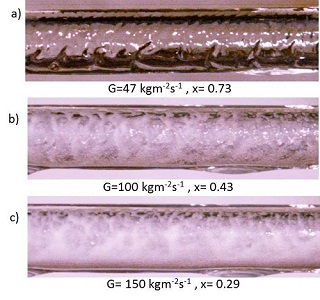
Flow Pattern Visualisation
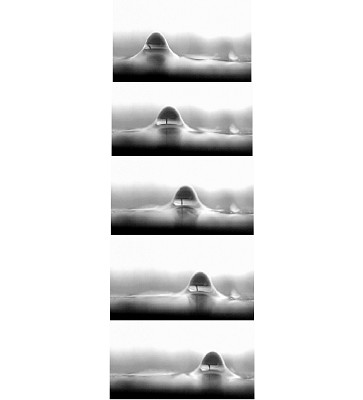
Analysis Of Rapid Phase Transition In Liquid Natural Gas Spill.
Sponsor: SERB (DST)
Project Outlay: ₹35 Lacs
Prof. Arup Kumar Das
Abstract
The demand for natural gas (NG) is expected to rise steadily and the world’s resources of NG are easily sufficient to accommodate the projected increase in demand. India is increasing its NG production and extending it towards the sea, and liquefied natural gas (LNG) transport by carrier ships will be a competitive method of bringing the gas to markets. With this expected increase in maritime production, transportation and use of LNG, the safety aspect of these activities will become increasingly important. One of the main safety concerns of LNG operations is Rapid Phase Transition (RPT), sometimes also called vapour/physical explosions. When spilled into water, LNG is observed to suddenly, and seemingly at random, explosively vaporize in large quantities at once. The RPT explosion involves dangerous pressure waves, which will harm equipment and personnel. In addition, RPT will also significantly increase the fire hazard, both due to increased dispersion of the flammable NG vapour cloud at the spill site, and the potential to create fire balls if triggered after a fire has already started.
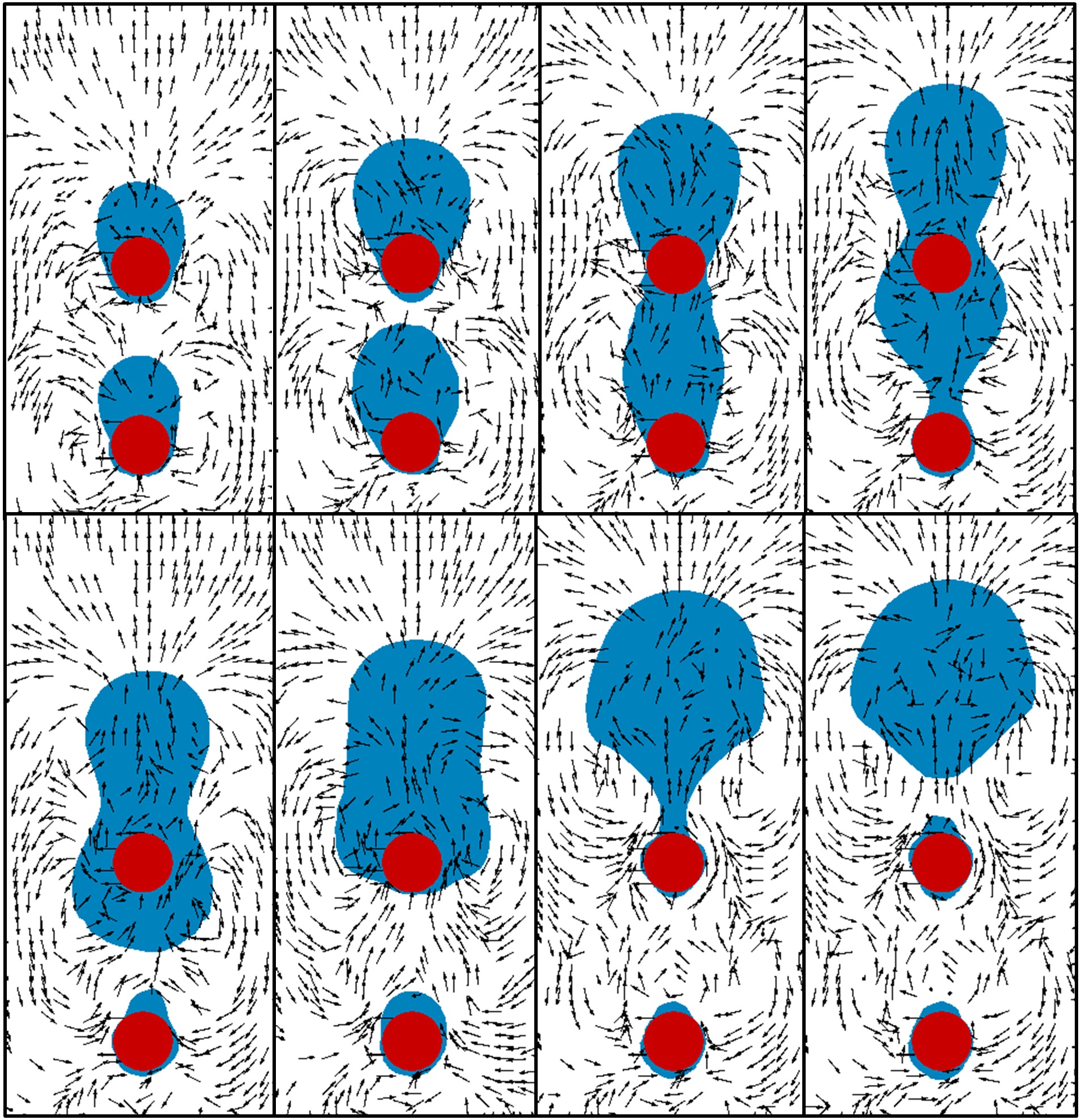
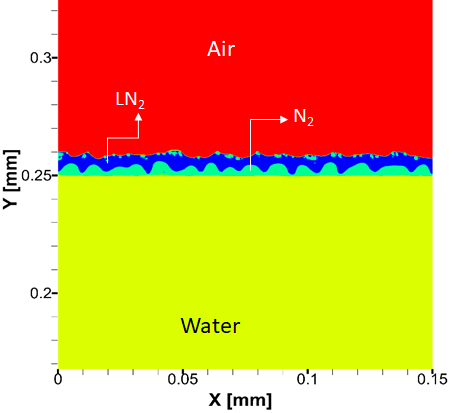
The current level of understanding does not appear to allow such confidence. A complete model is needed to properly assess the risks of RPT events during LNG spills, understand how to best avoid them, and reduce their consequences if they should occur. Present project aims towards that. Numerical modeling of liquid nitrogen (LN2) spillage on water has been carried out inside a rectangular box using volume of fluid based computational multifluid dynamics.Initially nitrogen (N2) gas forms rapidly, moment it comes in contact with water due to very high temperature difference. Presence of vapor hinders the heat transfer, vapor growth decreases.Velocity and turbulent intensity increases until t = 0.01 s, due to the formation of N2 gas.
Numerical Analysis Of Liquid-Nitrogen (LN2) Spillage On Water.
Numerical Analysis Of Liquid-Nitrogen (LN2) Spillage On Water
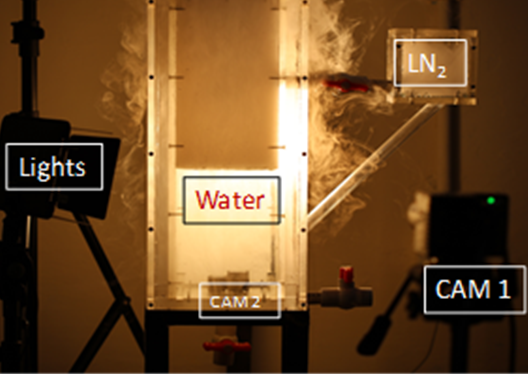
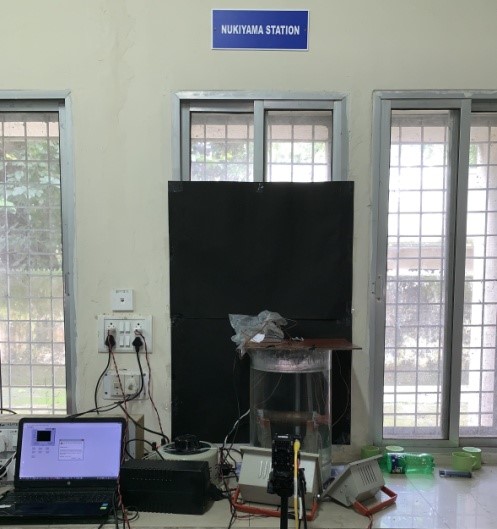
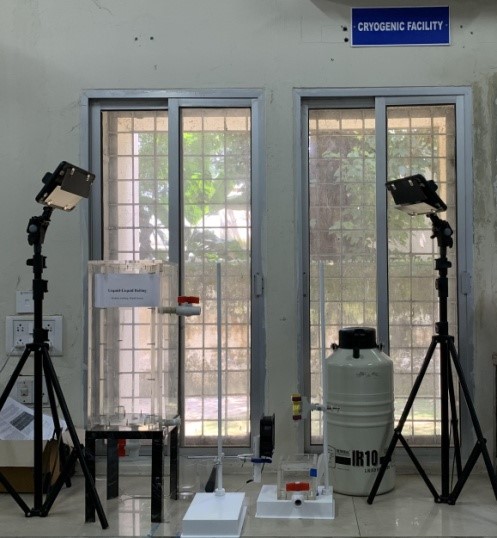
Experimental Analysis Of Liquid-Nitrogen (LN2) Spillage On Water
Development Of Numerical Models For Entrainment And Deposition Rates To Predict Dryout In AHWR Fuel Bundle.
Sponsor: BRNS
Project Outlay: ₹23 Lacs
Prof. Arup Kumar Das
Abstract
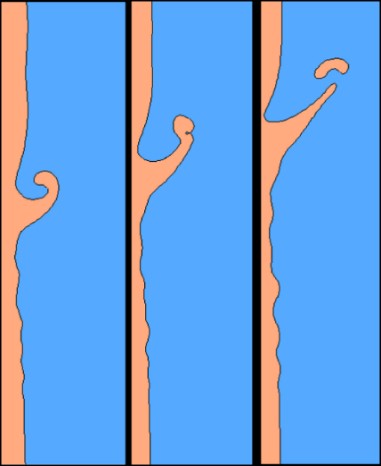
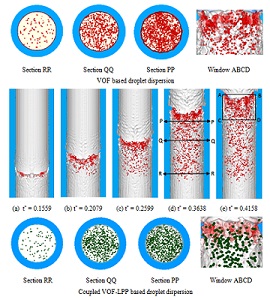
Transformation from annular to droplet flow is investigated for co-current, up-ward gas-liquid flow through a cylindrical tube using grid-based volume of fluid framework. Three transitional routes, namely, orificing, rolling, and undercutting are observed for flow transformation at different range of relative velocities between the fluids. From physical understanding of the flow behavior, a regime map is also proposed to categorize different transition mechanisms.
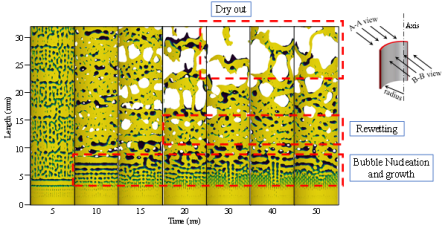
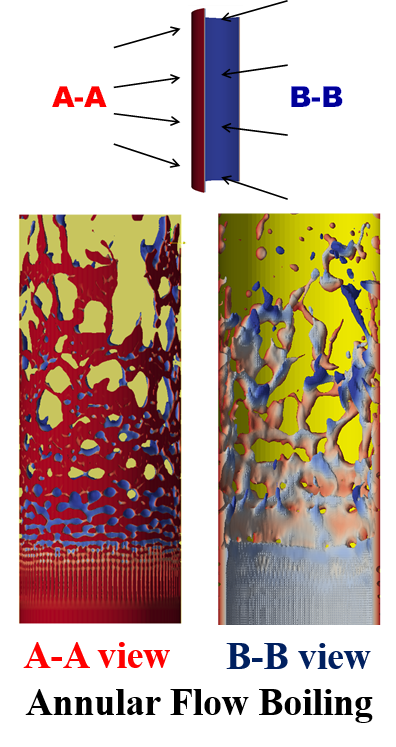
Numerical modeling of two-phase annular flow boiling has been carried out inside a tube using volume of fluid based computational multifluid dynamics. Entrainment from liquid-vapor interface and boiling from the solid-liquid interface are captured from basic hydrodynamics before predicting the route towards the dryout condition. The stages of bubble nucleation, growth, merging, bursting, droplet entrainment, film rewetting, and dryout has been clearly visualized for diabatic annular mist flow. The bubble evolution was quantified in terms of bubble radius and contact length over space and time. To signify the dryout condition, plots of liquid phase fraction and average heat transfer coefficient were plotted which shows decreasing trends with space. Effect of different wall degree of superheats and gas-liquid velocities at a higher working pressure of 40 bar have been studied, which can be commonly be observed in BWR conditions. Dryout is found to happen early in the axial length if the degree of superheat and flow velocities increases. Overall interfacial structure in the azimuthal and axial direction are found to be chaotic, which has been analyzed mean, standard deviation and attractor plot of space time-varying values of liquid phase fraction.
Three-Dimensional View (From AA Direction) Of The Temporal Evolution Of Liquid Film Across The Pipe Length
Development Of New Enhancement Tube.
Flow Pattern Visualisation.
Development Of A Cost Effective Left Ventricular Assist Device (LVAD) With Centrifugal Mechanical Circular Drive Systems And Associated Control.
Sponsor: MHRD and ICMR
Project Outlay: ₹205 Lacs
Prof. Arup Kumar Das
Abstract
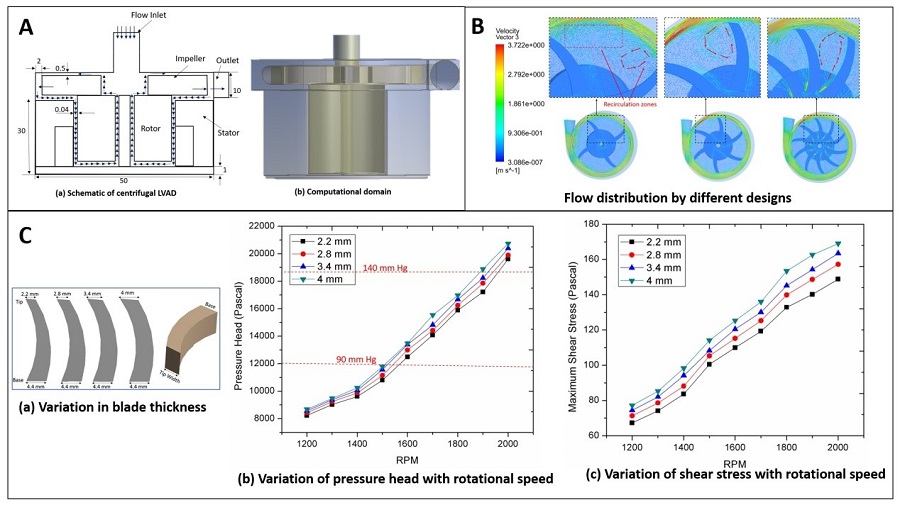
Left ventricular assist device (LVAD) provides an effective artificial support system to the heart patients. Despite the improved life survival rate, complications like hemolysis, blood trauma, and thrombus formation still limit the performance of the blood pump. The designed VAD must satisfy some physiological parameters like the blood flow rate, pressure head etc and also some critical parameters like pump weight, size, and permissible shear stress generation to avoid thrombus formation and blood damage. The present work is targeted to develop an optimum design of blood pump for left ventricular assist device which is capable enough to perform the functions of a damaged left ventricle of the human heart. The design of blood pump of an LVAD involves incredible accuracy and thorough understanding of hemodynamics to mimic the functionality of a failed ventricle. In particular, simulation studies are carried out to obtain a cost-effective design of an LVAD by optimizing the geometrical parameter of the centrifugal pump like blade profile, blade number, blade tip width and inclusion of splitter blades.
A 3-dimensional simulation study on the LVAD pump is carried out by utilizing computational fluid dynamics software ANSYS-CFX at different rotational speed and flow rate. A new simulation approach is adopted by implementing the non-Newtonian blood flow model to precisely capture the variation if blood flow fields due to rotating blades. The conceptualized design of baseline model of the pump are shown in Figure 1(a). Improvement in performance of the blood pump has been achieved by tuning its geometrical features as shown in Figure 1(b) and (C). An optimum design of centrifugal blood pump for the assistance of failed ventricle is proposed which can effectively pump the blood from the left ventricle to the ascending aorta. The proposal can be adopted by LVAD designers to have hemodynamically tuned efficient product.
Design Proposed For Improved Impeller Blades In Centrifugal LVAD (B) Improvement In Flow Distribution By Backward Blades And (C) Performance Improvement By Thick Blade Impeller.
A Comprehensive Study Of Drop Dynamics And Its Manipulation Due To Electro-Wetting
Sponsor: DST
Project Outlay: ₹16.6 Lacs
Prof. Arup Kumar Das
Abstract
Investigation of upward climbing motion of a droplet over an inclined surface using electrowetting will be performed. Understanding the influence of substrate contact angle on an electrically actuated droplet over inclined and humped surfaces will be established from fundamental physics. We will estimate of a temporal voltage map to produce constant drop motion over non-planer surfaces. .
Analysis of internal flow structure and surface deformation during the uphill movement of sessile droplets by electrostatic actuation will be targeted. Investigation of droplet coalescence propelled by dielectrophoresis will be also tested. Analysis of electrostatic incitation on the wetting mode of a nano-drop over pillar-arrayed surface will be numerically observed. Study of wetting behavior of a translating sessile nano-drop under electrostatic actuation will be performed. Fabrication and characterization of a cost effective electrowetting setup with an effort to reduce the threshold actuation potential will be targeted.
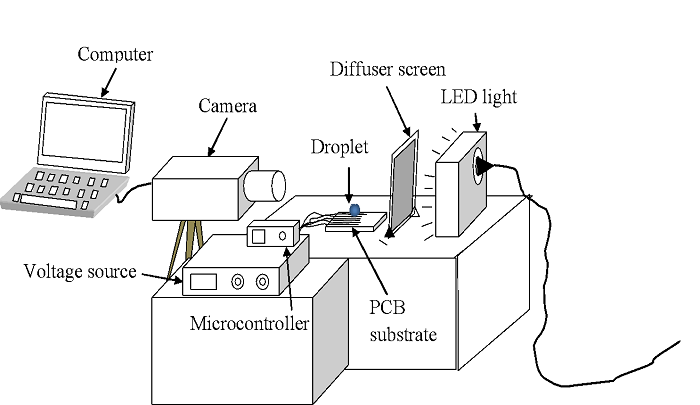
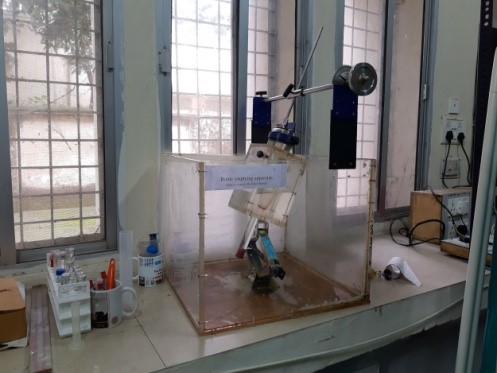
Schematic Diagram Of Experimental Setup.
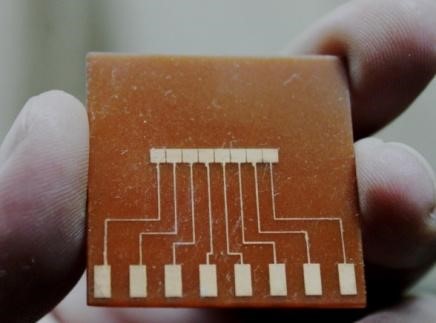
Developed Surface And Electrodes For Electrowetting
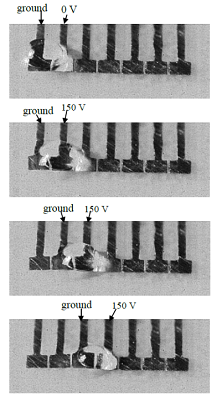
Drop Translation In Electrowetting
Drop Translation In Dielectrophoresis
Development Of Unified Model For Micro And Macroscopic Two Phase Interfaces By Coupling Eulerian And Langrangian Framework.
Sponsor: BRNS
Project Outlay: ₹21 Lacs
Prof. Arup Kumar Das
Abstract
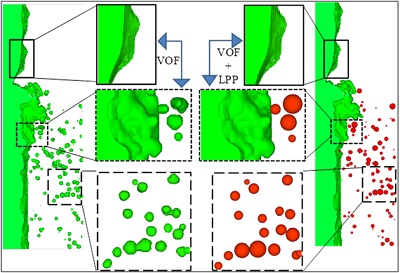
Developed a unified model which can predict both micro and macro scale interfaces. Coupling of Eulerian two fluid model along with Lagrangian smoothed particle hydrodynamics technique has been done. Individual particle positions and velocities are predicted by solving Liouville equation in Lagrangian framework. Incorporate population balance method has been adopted to obtain bubble size scatter for bulk forces in Eulerian space. Under this project, concept of diffused interface is used for segregating zones of particles and cells around the interface and hence control their mutual interactions. Validation of developed hybrid model with available experimental data with literature..
Demonstration Of Multi-Scale Features In Annular To Dispersion Transition.
Numerical Demonstration Of Droplet Dispersion Inside A Tube As Time Progresses (A-E).

.jpg)
.jpg)






 Spillage On Water..png)