Contact Us
O.C.: Dr. Sadhan Ghosh
A.O.C.: Dr. B. S. S. Daniel
Lab Supervisor: Mr. Narendra Kumar
Scholar Assistance: Mr. Sandeep Kumar
Thermo-Calc: This software consists of several modules for specific purposes and various tasks the user may be interested to perform during calculation.
TDB module is used for retrieving databases or data files.
GES (Gibbs Energy System) module lists thermodynamic data being stored earlier for a system. A larger number of model for the composition dependence of the Gibbs energy have been implemented in GES.
POLY module can calculate various complex heterogeneous equilibria.
POST module makes it possible to plot many kinds of phase diagrams and property diagrams.
PARROT module provides a useful and flexible tool for data evolution and assessment of experimental data.
TAB module tabulates various properties for pure substances or mixtures or chemical reactions.
BIN and TERN modules are designed to plot phase diagrams and property diagrams for various binary and ternary system.
POT module is used to illustrate gas speciation and partial pressures in gas-bearing interaction systems.
POUBAIX module is used to plot pH-Eh and other aqueous property diagrams for heterogeneous interactions involving complex aqueous solutions.
SCHEIL module is designed to simulate solidification process where no kinetic description is needed, using the Scheil-Gulliver model.
REACTOR module is used to simulate mass transfer and energy transport in multi-staged steady-state processes.
Utility of Thermo-calc in the alloy development program:
Calculating equilibrium phase diagram for binary and multicomponent systems
Calculation of phase fraction and alloy constituents in an equilibrium phase
Calculation of the A3 temperature of steels and the influence of each alloying element on this temperature.
Calculation of a para-equilibrium and the T0 temperature for non-equilibrium phase transformations.
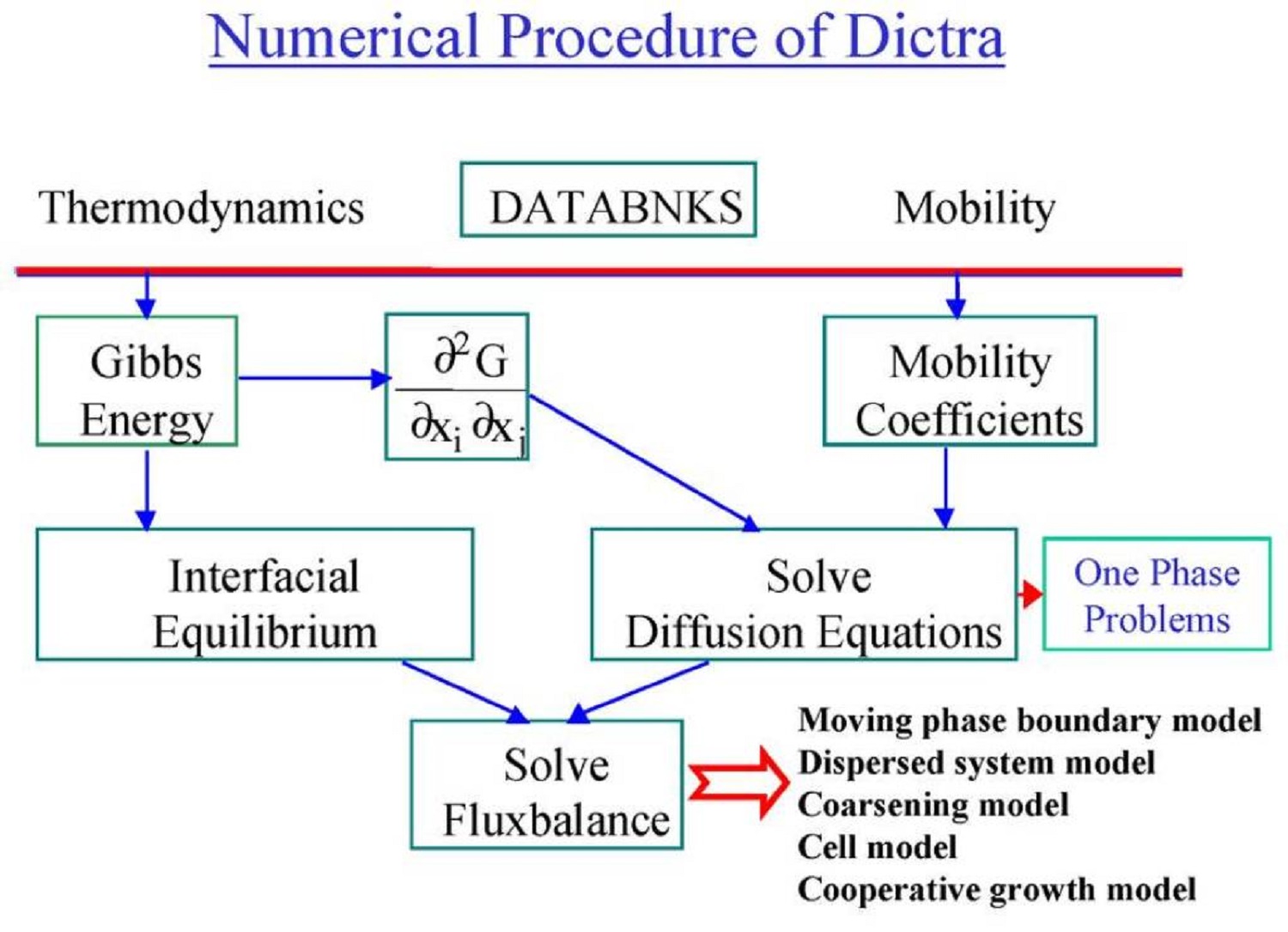
Dictra: Software package for simulation of diffusional controlled Transformations in multicomponent alloys, in association with Thermo-Calc.
It is the result of more than 20 years and 60 man-years R&D at KTH in Stockholm, Sweden, in cooperation with the Max-Planck Institute fürEisenforchungin Düsseldorf, Germany.