About
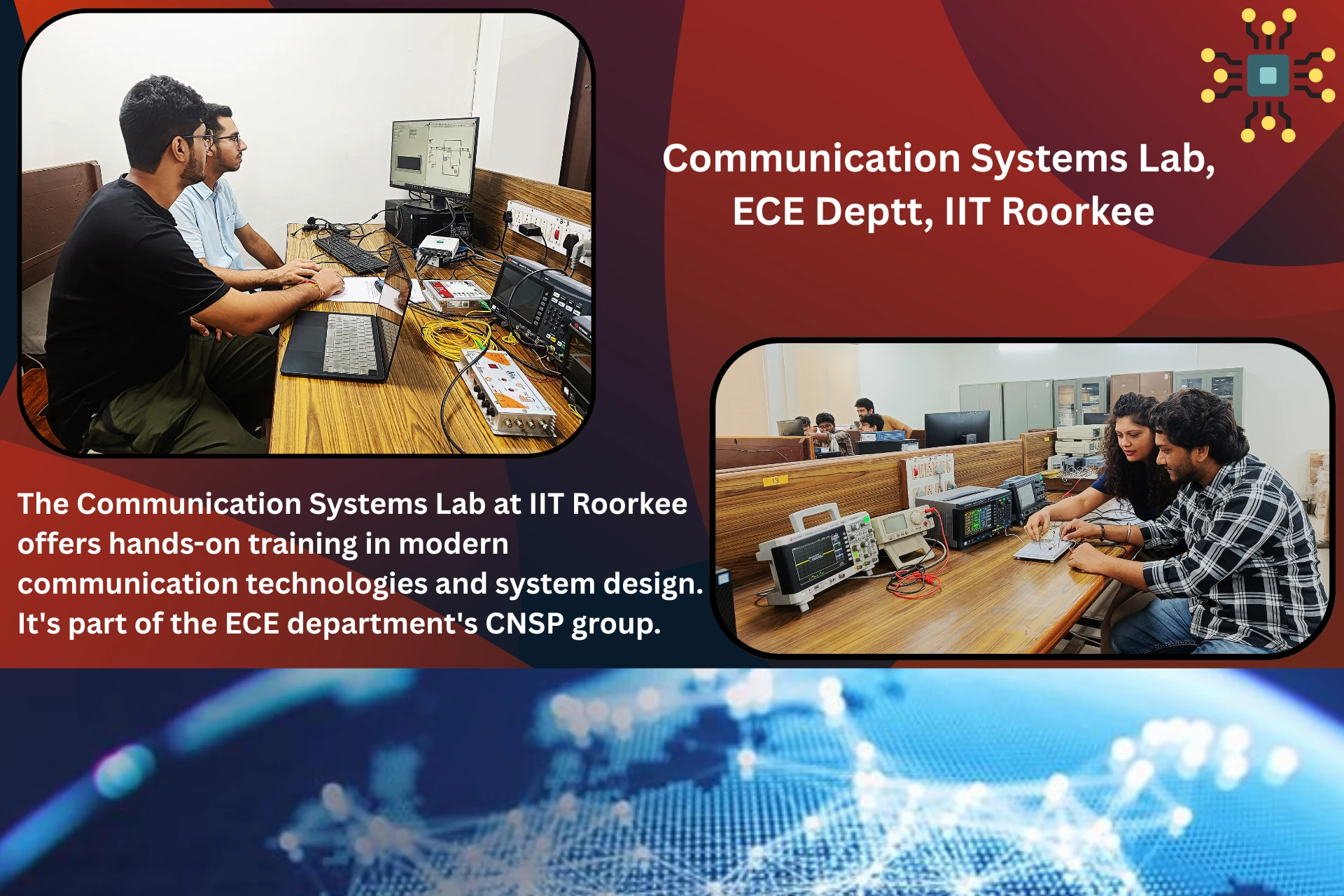
In today’s rapidly advancing technological landscape, hands-on experience with practical systems is critical for students of Electronics and Communication Engineering (ECE). The Communication Systems Lab at IIT Roorkee plays an essential role in delivering experiential learning to approximately 150 students across both undergraduate and postgraduate programs each semester.
The lab offers hands-on experience in analog, digital and wireless communication systems, allowing students to gain valuable skills in signal modulation, transmission, and reception, among other topics.
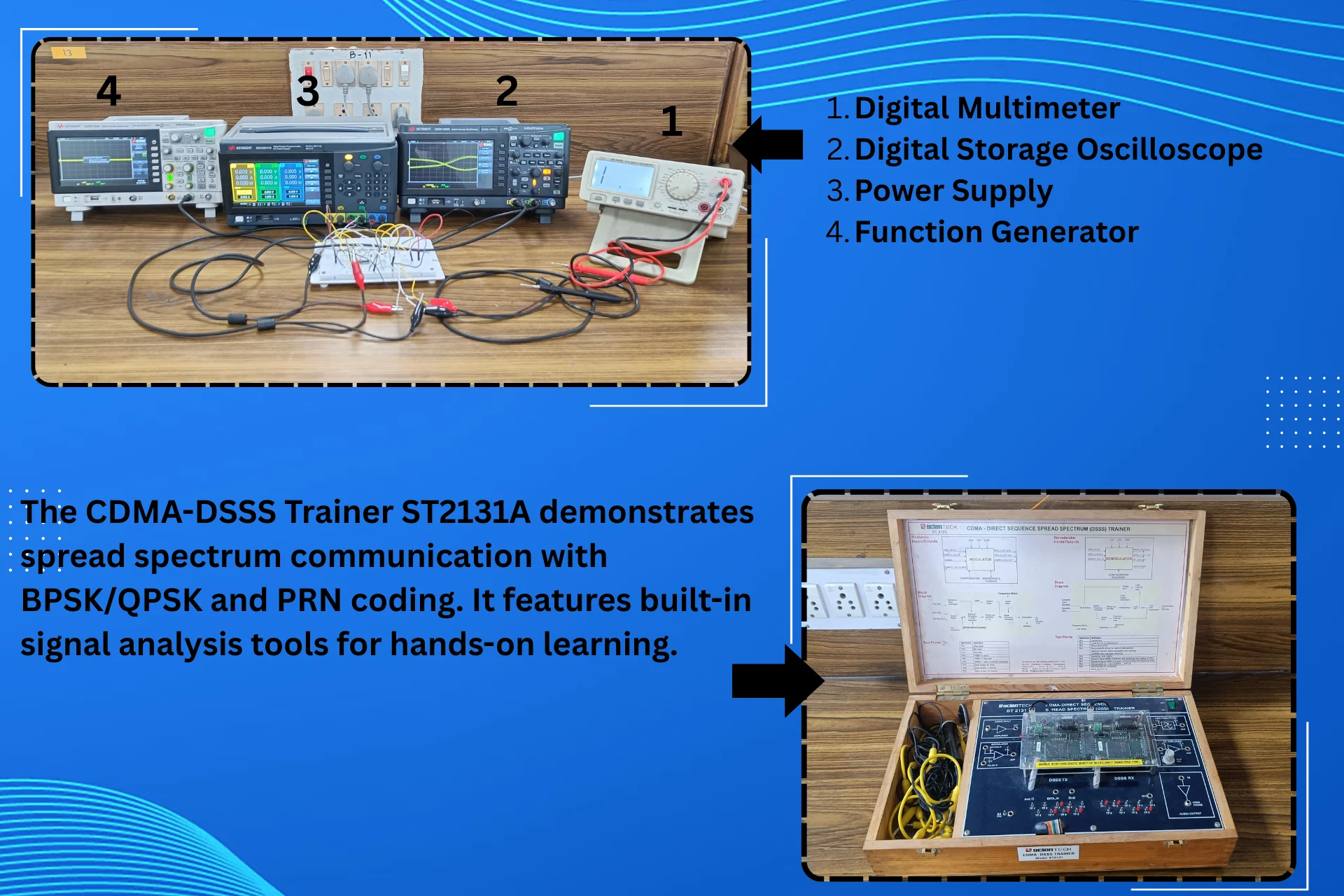
Currently, Communication system lab performance focuses on evaluating a system's effectiveness by measuring key metrics like data rates, error rates, and signal quality under various conditions. Students and researchers analyse theoretical concepts through hands-on implementation and simulation, comparing simulated and measured results to understand the impact of modulation, coding, and channel impairments, ultimately striving to optimize system efficiency and reliability for practical applications. the Communication Systems Lab houses a set of basic instruments such as Digital Storage Oscilloscopes (DSO), Power Supplies, Function Generators, and USRP Kits, which is used to hosts a series of experiments that provide fundamental knowledge in communication engineering.
These include:
1. ASK and BPSK Modulator Design
2. AM-DSB Modulation and Demodulation
3. Sample and Hold Circuit Fabrication
4. VCO Characteristic Observation
5. FM Modulation and PLL Analysis
6. PPM and PWM Modulator Design
7. BPSK Modulation using NI LabVIEW
8. Advanced Digital Modulation Schemes
• Quadrature Amplitude Modulation (QAM) Transmission and Reception: Design and analyze 16-QAM and 64-QAM schemes using LabVIEW.
• Error Rate Measurement in Digital Communication: Using USRP and LabVIEW, students will transmit and receive BPSK/QPSK signals over various channel conditions, analyzing Bit Error Rate (BER) for each modulation scheme.
• Channel Coding and Decoding: Experiment with encoding techniques (such as Hamming or Convolutional codes) and observe error correction using real-time noisy channels.
9. Advanced Wireless Communication Techniques:
• MIMO System Design: Implement a basic 2x2 and 4x4 MIMO system using NI USRP and LabVIEW, enabling students to observe the benefits of MIMO technology, such as increased data rates and reliability in wireless communication.
• Performance Metrics and Analysis: Evaluate MIMO performance in terms of Bit Error Rate (BER) and Signal-to-Noise Ratio (SNR) under various simulated channel conditions.
• Beamforming and Spatial Multiplexing: Demonstrate beamforming techniques and spatial multiplexing to show how MIMO systems improve spectral efficiency and enhance communication robustness in multipath environments.
Lab Courses:
1. UG Students: B.tech 3rd year( ECN-352)
2. PG Students; M.tech 1st year(ECN-502)
Contact Us
Dr. Ekant Sharma
Dr. Abhay Kumar Sah
Department of Electronics & Communication
Indian Institute of Technology Roorkee
Haridwar Highway, Roorkee,
Uttarakhand 247667